Shogi Rules: 8 Piece Moves and Basic Play
Published

For those just starting Shogi, here is a summary of the essential rules. Let us look step by step at how pieces move on the board and how to trap the opponent's king.
Conclusion: Shogi is a game where you learn the movements of 8 kinds of pieces, reuse captured pieces, and win by being the first to checkmate the opponent's king.
Shogi Rules and the 8 Basic Pieces
The basic rules of Shogi are the set of regulations for moving 8 kinds of pieces on a 9x9 board to capture the opponent's king.
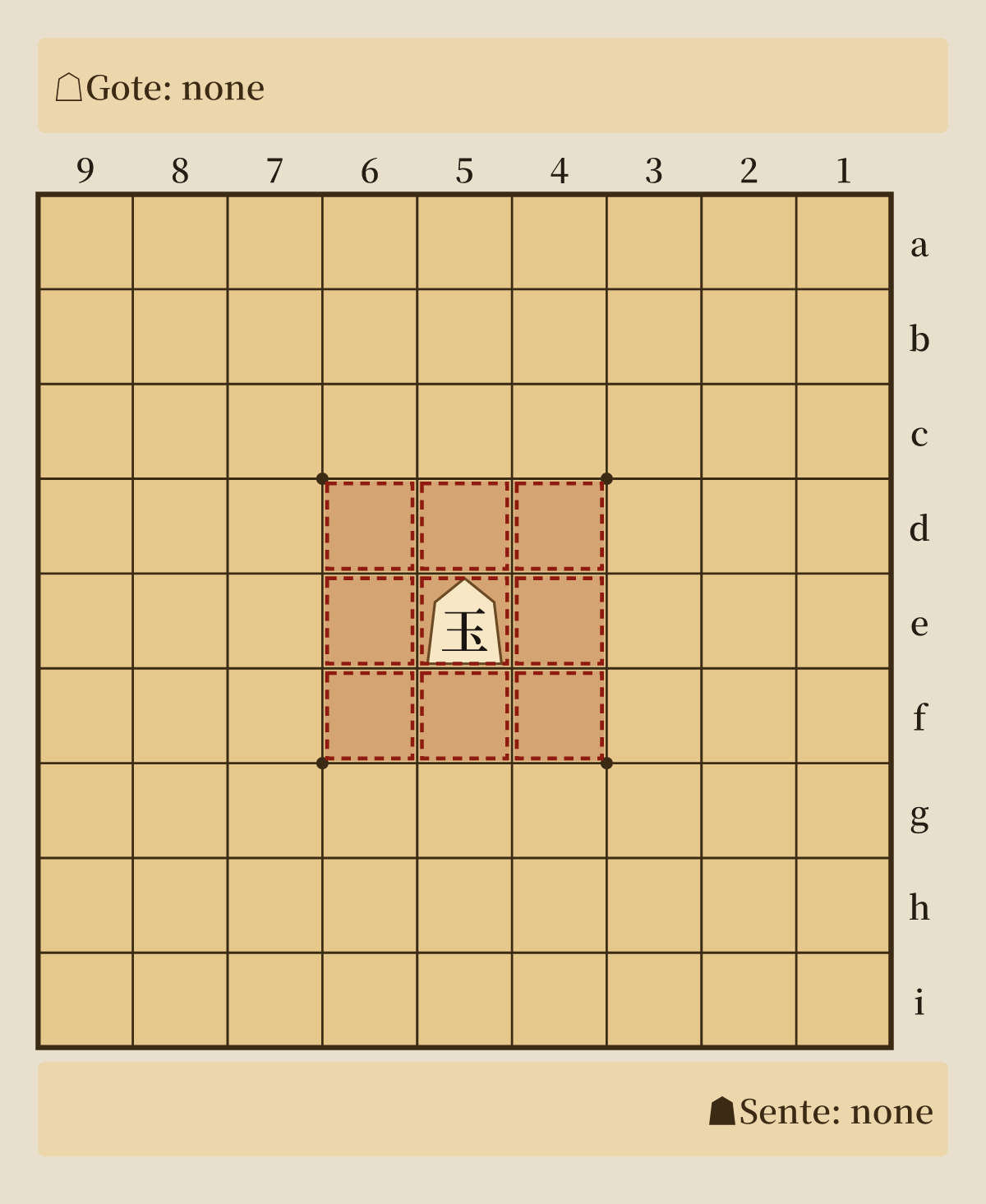
Figure 1 as text
Gote: none
Gote in hand: none
Sente: 5e king
Sente in hand: none
To move: Sente
Highlighted squares: 5e 4d 4e 4f 5d 5f 6d 6e 6f
SFEN: 9/9/9/9/4K4/9/9/9/9 b - 1
This diagram shows the 9 squares reachable by the king located at 5e in the center of the board. The king can move 1 square in any direction—forward, backward, sideways, or diagonally—but cannot move to a square covered by an opponent's piece.
| Item | Details |
|---|---|
| Board Size | 9 ranks by 9 files, total 81 squares |
| Victory Condition | Putting the opponent's king in checkmate |
| Reusing Captured Pieces | Pieces captured from the opponent can be dropped on empty squares on your turn |
| Try in the App | Computer games in Grand Court |
Basic Move Procedure and Defense Against Attacks
The basic flow of playing a Shogi match consists of advancing a pawn to open paths, establishing defenses, and then attacking the opponent's camp.
- On move 1, advance a pawn to open the bishop's or rook's path, making it easier for pieces to move forward.
- Move the king from its initial square to a safe location, and build a castle with gold and silver generals for defense.
- Advance silver generals and knights to the frontline, aiming to break through the opponent's camp and start an attack.
- Promote pieces that enter the promotion zone to increase fighting strength and close in on the opponent's king.
Figure 2 as text
Gote: 9a lance, 8a knight, 7a silver, 6a gold, 5a king, 4a gold, 3a silver, 2a knight, 1a lance, 8b rook, 2b bishop, 9c pawn, 8c pawn, 7c pawn, 6c pawn, 5c pawn, 4c pawn, 3c pawn, 2c pawn, 1c pawn
Gote in hand: none
Sente: 7f pawn, 9g pawn, 8g pawn, 6g pawn, 5g pawn, 4g pawn, 3g pawn, 2g pawn, 1g pawn, 8h bishop, 2h rook, 9i lance, 8i knight, 7i silver, 6i gold, 5i king, 4i gold, 3i silver, 2i knight, 1i lance
Sente in hand: none
To move: Gote
Last move: 7g→7f
Highlighted squares: 7f 8h
SFEN: lnsgkgsnl/1r5b1/ppppppppp/9/9/2P6/PP1PPPPPP/1B5R1/LNSGKGSNL w - 2
This diagram shows the position after Sente pushes the pawn at 7f on move 1. Pushing the square at 7f opens the diagonal line for the bishop at 8h, making it easier to seize the opening initiative.
Countermeasures When Under Attack
When opponent pieces approach your camp, do not panic into attacking; receive them with defensive pieces. Leaving the king on its starting square invites focused attacks, so build a solid formation like the Mino castle and use your gold and silver generals to firmly meet enemy offensive pieces.
Try this procedure in the computer matches (offline) of Grand Court. The opponent offers 6 levels from beginner to master, and because it thinks inside the device, you can play through to the end even without a signal.
Play in the app
The fastest way to understand concepts you read about is to test them in play. You can play against the computer, which thinks on the device, all the way to the end without an internet connection.


Role Comparison and Features of the 8 Pieces
Comparing piece roles means understanding differences in mobility and direction, using each piece appropriately according to the board situation.
| Piece Type | Movement Characteristics | Power When Promoted | Main Role |
|---|---|---|---|
| King | 1 square in all directions | Cannot promote | The vital leader that must be protected |
| Rook / Bishop | Long straight lines vertically/horizontally or diagonally | Promote to dragon or horse, reaching all surrounding squares too | Major pieces that break down enemy camp from afar |
| Gold General / Silver General | 1-square steps strong in forward direction | Promoted silver moves the same as a gold general | Minor pieces guarding the king or aiding the frontline |
| Knight / Lance / Pawn | Jump or advance forward | Promote to move like gold (such as tokin) | Spearheading attacks and creating footholds |
Figure 3 as text
Gote: 9a lance, 8a knight, 7a silver, 6a gold, 5a king, 4a gold, 3a silver, 2a knight, 1a lance, 8b rook, 2b bishop, 9c pawn, 8c pawn, 7c pawn, 6c pawn, 5c pawn, 4c pawn, 3c pawn, 2c pawn, 1c pawn
Gote in hand: none
Sente: 7f pawn, 4f pawn, 9g pawn, 8g pawn, 6g pawn, 5g pawn, 3g pawn, 2g pawn, 1g pawn, 8h bishop, 6h rook, 5h gold, 3h silver, 2h king, 9i lance, 8i knight, 7i silver, 4i gold, 2i knight, 1i lance
Sente in hand: none
To move: Sente
Highlighted squares: 2h 3h 4i 5h
SFEN: lnsgkgsnl/1r5b1/ppppppppp/9/9/2P2P3/PP1PP1PPP/1B1RG1SK1/LNS2G1NL b - 1
This diagram shows the Hon-Mino castle setup where Sente moves the king to 2h, protected by the silver general at 3h and gold generals at 5h and 4i. Commonly used with swinging rook when moving the rook to 6h, keeping the king toward the edge with coordinated defenders makes it resilient against enemy attacks.
Piece Setup and Initial Position
Conclusion: Pieces are arranged across the 3 ranks closest to you. Place the king on 5i in the center of rank 1, then expand outward on both sides with gold, silver, knight, and lance in order. On rank 2, place the bishop at 8h on the left and the rook at 2h on the right, and line up 1 pawn on each of the 9 squares from 9g to 1g on rank 3 to complete the 20 pieces.
- Rank 1 (closest): Lance, Knight, Silver, Gold, King, Gold, Silver, Knight, Lance
- Rank 2: Bishop (left 8h) and Rook (right 2h)
- Rank 3: 1 Pawn on each of all 9 squares
There is no official rule for the order of placement, but traditional methods like the Ohashi style, placing pieces outward from the king, are widely used. The opponent sets up the same formation facing you, and after determining Sente and Gote, the game begins.
How to Memorize Piece Movements
Conclusion: You will learn piece movements quickest by pairing similar pieces and remembering only the differences. First, use the king, which moves 1 square in all directions, as the baseline; learn by subtraction that the gold general cannot move to the 2 diagonally backward squares, and the silver general cannot move sideways or directly backward (3 squares). Next, pair the rook, which advances any distance orthogonally, with the bishop, which advances any distance diagonally. For the pawn, lance, and knight, which can only move forward: the pawn moves 1 square, the lance goes straight forward any distance, and the knight jumps to the front left or right 2 squares ahead.
Upon promotion, pawn, lance, knight, and silver general move like gold general, while rook becomes dragon and bishop becomes horse, each adding 1-square steps to its original movement. Practicing with real puzzles reinforces these movements. Try Today's Tsume Shogi 1-Move Puzzle (No.001) to see which piece gives check so the king cannot escape.
Good Moves for Improvement and Pitfalls Beginners Fall Into

Evaluating moves in a match means contrasting good examples that advance while maintaining balance against bad examples that result in illegal moves or isolated pieces.
| Situation | Good Example | Common Mistake |
|---|---|---|
| Handling King in Opening | Build a castle with gold and silver, moving king to the side | Starting a battle with king left on file 5 |
| Pawn Use and Violations | Use 1 per file and make tokin in the promotion zone | Two Pawns (nifu) violation by dropping 2 pawns on the same file |
| Using Pieces in Hand | Drop pieces on key squares to restrict the opponent king | Drop pawn mate violation by directly mating with a dropped pawn |
| Piece Use in Enemy Zone | Choose to promote based on position to strengthen forces | Advancing pawn or lance to furthest rank, becoming a piece with no moves |
In Shogi, observing fundamental rules, avoiding fouls, and coordinating pieces is the fastest route to improvement. Verify where your pieces can move and proceed calmly, move by move.
Frequently asked questions
Can I practice Shogi rules and piece movements in an app?
You can easily practice with computer matches in Grand Court. Since the engine runs entirely on your device, you can play offline against opponents matched to your skill level.
How can I use pieces captured from the opponent?
Captured pieces become your pieces in hand and can be dropped freely onto any empty square on your turn, provided the drop is not an illegal move.
Which illegal moves should beginners be especially careful of?
Two Pawns (nifu), which is placing 2 pawns on the same vertical file, and drop pawn mate, which is directly checkmating the king by dropping a pawn. Dropping or advancing a piece so it becomes a piece with no moves also results in a loss by illegal move.
Is there a set order for arranging Shogi pieces?
While there is no strict official rule, traditional methods like the Ohashi style, placing pieces outward from the central king, are common. Placing the king in the center of rank 1, followed outward by golds, silvers, knights, and lances, then bishop and rook, and finally the pawns on rank 3, is considered an orderly procedure.
Are there any pieces that can jump over other pieces?
Only the knight can jump over other pieces. It leaps diagonally forward to squares 2 ranks ahead, making it the sole piece capable of hopping over intervening friendly or enemy pieces.
Play in the app
Become a mechanical daimyo and conquer 50 Sengoku court matches in the Shogi app Shogi: The Grand Court. Free to start (with in-app purchases).