What Is Two Pawns (nifu) in Shogi? Tokin Rules and Illustrated Fouls
Published Updated
Conclusion: Two Pawns (nifu) in Shogi means having 2 of your unpromoted pawns on the same vertical file, resulting in an immediate loss by illegal move. A tokin does not count as a pawn, so you can drop a pawn on a file with only a tokin. It differs from drop pawn mate in shogi, which checkmates the king by dropping a pawn.

| Item | Two Pawns (nifu) Rule |
|---|---|
| Illegal Formation | 2 unpromoted pawns of your own on the same file |
| Pieces Not Counted | Tokin and opponent pawns |
| When It Happens | Only when dropping a pawn from pieces in hand (pawns only move forward) |
| Result of Move | Immediate loss by illegal move |
| Practice in App | Cannot drop a pawn that causes Two Pawns (nifu) against computer in Shogi: The Grand Court |
The Basic Objective of Shogi and How 8 Piece Types Move
Shogi is played on a 9×9 board of 81 squares. Players take turns moving 1 piece to corner the opponent's king, and the one who creates checkmate wins.
There are 8 piece types: the pawn moves forward 1 square, the lance moves forward any distance, the knight jumps forward diagonally, the silver general moves in 5 directions (forward and diagonally), and the gold general moves in 6 directions (forward, diagonally forward, sideways, backward). Additionally, the bishop moves diagonally, the rook moves orthogonally, and the king moves 1 square in all directions. See Shogi piece movements for diagrams.
When entering, moving within, or exiting the opponent's promotion zone (the farthest 3 ranks), you can promote a piece to upgrade it. Deciding whether to promote or stay unpromoted is a key feature of Shogi.
Two Pawns (nifu) and Basic Rules for Pieces in Hand That Beginners Should Note
Two Pawns (nifu) in Shogi is an illegal move where you place 2 of your unpromoted pawns on the same file. Because pawns only advance straight forward 1 square, moving a pawn on the board never creates it; it happens only when dropping a pawn from pieces in hand.
You cannot have 2 of your own pawns on the same file at once; doing so results in an immediate loss by illegal move. In contrast, a tokin, which moves like a gold general after promotion, is treated separately from a pawn.
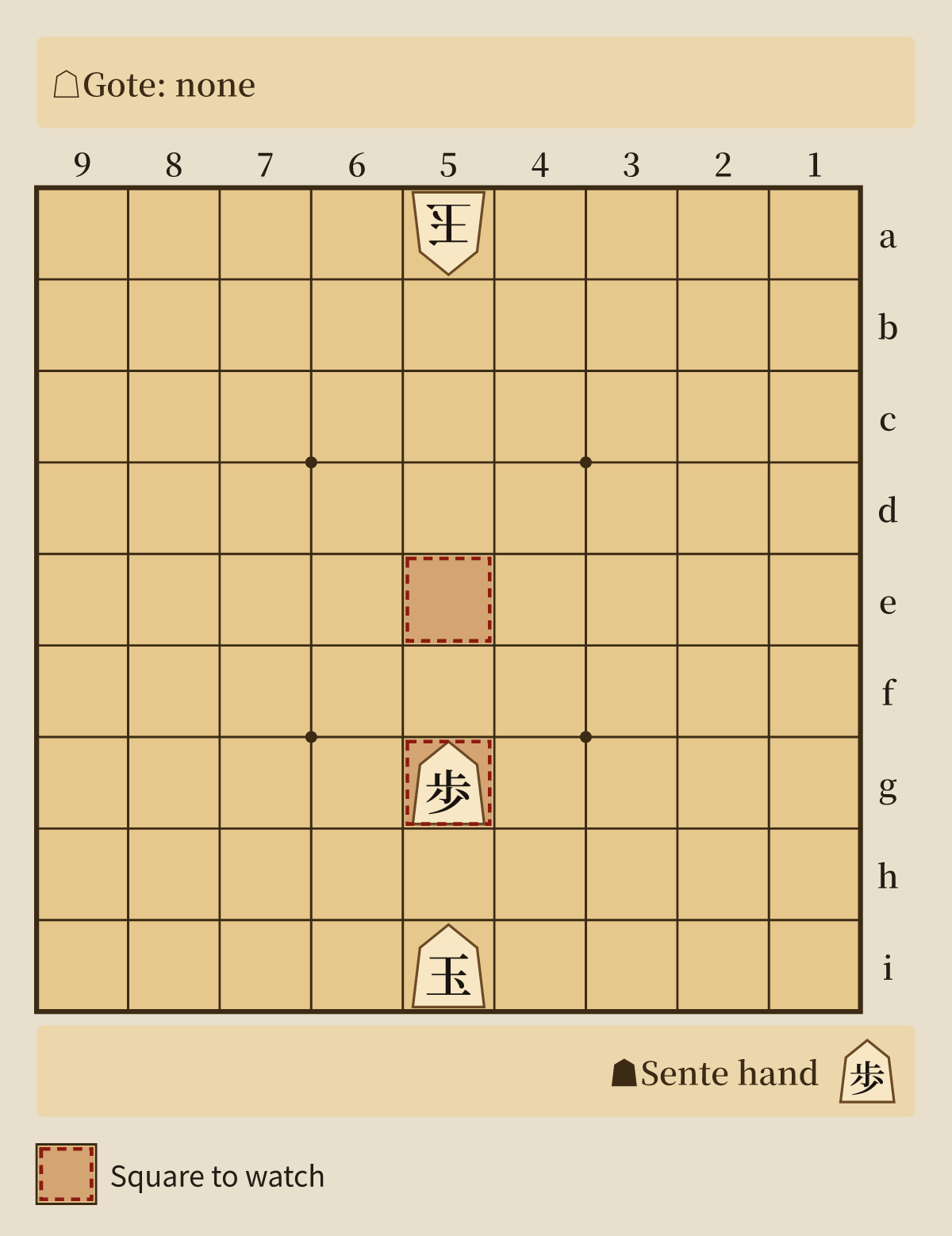
Figure 1 as text
Gote: 5a king
Gote in hand: none
Sente: 5g pawn, 5i king
Sente in hand: pawn
To move: Sente
Highlighted squares: 5g 5e
SFEN: 4k4/9/9/9/9/9/4P4/9/4K4 b P 1
In this diagram, Sente's pawn is on 5g. Dropping a pawn onto file 5, such as on 5e, is Two Pawns (nifu). Since there is no Sente pawn on file 4, dropping on 4e is allowed.
| File Status | Can Drop Pawn? | Reason |
|---|---|---|
| No pawn of your own | Can drop | Can place without issues |
| Already 1 pawn of your own | Cannot drop | Becomes Two Pawns (nifu) foul |
| Only your own tokin | Can drop | Tokin is not treated as a pawn |
| Only opponent's pawn | Can drop | Opponent pieces do not matter |
Figure 2 as text
Gote: 5a king
Gote in hand: none
Sente: 5d tokin, 5i king
Sente in hand: pawn
To move: Sente
Highlighted squares: 5d 5f
Arrows: pawn drop 5f
SFEN: 4k4/9/9/4+P4/9/9/9/9/4K4 b P 1
Here, Sente's only piece on file 5 is the tokin on 5d, so dropping a pawn from pieces in hand onto 5f is not Two Pawns (nifu).
Checking whether your pawn remains lower on that file before dropping a pawn reliably prevents fouls.
Checking the Relationship Between Tokin and Two Pawns (nifu) with 3 Examples
Conclusion: A tokin is not counted for Two Pawns (nifu), so you can drop a pawn onto a file containing only a tokin. Whether it is Two Pawns (nifu) depends solely on whether your unpromoted pawn is on that file.
- A file with only a tokin: Dropping a pawn does not result in Two Pawns (nifu).
- A file with both a tokin and your pawn: Since there is 1 unpromoted pawn, dropping another pawn is Two Pawns (nifu).
- A file with only the opponent's pawn: The opponent's pawn does not count, so you can drop your pawn.
Promoting a pawn into a tokin lets you drop another pawn onto that file, which is a major advantage. To practice checking while avoiding fouls, try Today's 1-move checkmate problem (No.001).
Play in the app
Testing what you read by playing is the fastest route to learning. With the AI thinking on the device, you can play to the very end even without reception.


Scan with your phone to open the store
Key Illegal Moves to Remember Beyond Two Pawns (nifu)
Like Two Pawns (nifu), Shogi has several illegal moves that players may make by mistake. Reviewing them in advance helps beginners play with confidence.
Drop Pawn Mate and Pieces with No Moves
Drop pawn mate is a foul where dropping a pawn checkmates the king. Advancing a board pawn 1 square to checkmate is allowed, as explained in drop pawn mate in shogi. Also, dropping a pawn or lance on the farthest rank, or a knight on the farthest 2 ranks, is forbidden as a piece with no moves. When advancing there on the board, they must promote; other moves promote per conditions for promotion in shogi.
| Move | Description | Ruling |
|---|---|---|
| Two Pawns (nifu) | Placing 2 of your own unpromoted pawns on the same file | Loss by illegal move |
| Drop pawn mate | Dropping a pawn from pieces in hand to checkmate the king | Loss by illegal move |
| Pushed pawn mate | Advancing a pawn on the board 1 square to checkmate the king | Not a foul (win) |
| Piece with no moves | Dropping onto a square with no moves, or moving unpromoted | Loss by illegal move |
Difference Between Sennichite and Perpetual Check
Repeating the same position is called sennichite, usually resulting in a draw. However, if a player causes it by continuous checks (perpetual check), that player suffers a loss by illegal move.
Steps to Prevent Two Pawns (nifu) and Common Mistakes

Preventing Two Pawns (nifu) means verifying no pawn of yours remains on that file before dropping. The 3 steps are: 1. choose the file, 2. look along the file from your side to the promotion zone, 3. if your unpromoted pawn is there, choose another file or piece. A common error is missing a pawn on your near ranks. Valid moves include dropping on a file with only a tokin or on a file opened after exchanging pawns.
Try this in computer matches in Shogi: The Grand Court. Illegal drops are blocked, and matches run on the device without needing reception. No account registration is required.
In computer matches, you can use taking back a move up to 3 times per game. You can undo a move to try another, or review the game record from move 1 after the match.
Frequently asked questions
Does dropping a new pawn from pieces in hand onto a file with a tokin cause Two Pawns (nifu)?
Dropping a pawn on a file with a tokin is not Two Pawns (nifu). A tokin moves like a gold general and is distinguished from a pawn. If you have no unpromoted pawn on that file, you can freely drop a pawn from pieces in hand.
Is dropping a pawn from pieces in hand onto a file with an opponent's pawn Two Pawns (nifu)?
Dropping a pawn on a file with an opponent's pawn is not Two Pawns (nifu). The rule only forbids placing 2 of your own pawns on the same file. Opponent pieces do not matter, so you can safely drop a pawn.
What happens to the game if a player accidentally plays Two Pawns (nifu) in Shogi?
Playing Two Pawns (nifu) causes an immediate loss by illegal move because having 2 of your pawns on the same file is prohibited. Check the file carefully before dropping a pawn.
Does delivering check with a pawn from pieces in hand constitute a foul by itself?
Dropping a pawn to give check is not a foul. It is only illegal when dropping a pawn checkmates the king (drop pawn mate). If the king can escape, giving check with a pawn drop is completely fine.
Can I practice in an app without accidentally making a Two Pawns (nifu) foul?
In computer matches in Shogi: The Grand Court, moves that cause Two Pawns (nifu) cannot be played. Matches run offline on the device without an account.
Play in the app
Become a karakuri daimyo and win your way through 50 Sengoku court tournament matches in the Shogi app Shogi: The Grand Court. Free to play (includes in-app purchases).
Scan with your phone to open the store