Learning Shogi History from Scratch: Origins, Pieces in Hand, and Fouls
Published

Shogi, a traditional Japanese board game, is a profound pastime refined over many years. Unraveling the history of Shogi, cherished by many since ancient times, reveals how modern rules and the system of dan and kyu ranks showing playing strength took shape.
The standard board consists of 81 squares in a 9x9 grid, where players move their pieces aiming to checkmate the opponent's king. Let us first see how this ancient game crossed the seas and evolved into its present form.
From Ancient Origins to a Distinct Japanese Board Game
It is widely believed that Shogi traces its origins to the ancient Indian board game chaturanga. This pastime spread both west and east, transforming in the West into distinct board games and in the East into various related games. There are multiple theories regarding when it reached Japan, with records showing nobles playing by moving pieces as early as the Heian period.
From the medieval period through the Warring States period, large variations using many different pieces were played, but the number of pieces was gradually streamlined, converging on today's compact board. Over time, it spread widely among samurai and townspeople, fostering a culture of refining skills by preserving the game record of matches.
| Era | Main Characteristics | Board and Pieces |
|---|---|---|
| Ancient to Heian | Introduction from the continent and adoption | Presence of large boards with diverse pieces |
| Medieval to Warring States | Establishment of the pieces in hand rule | Consolidation to the modern 81-square board |
| Early Modern onward | Establishment of dan and kyu ranks and joseki | Spread to the public and accumulation of game records |
Reusing Pieces in Hand and Foul Rules Protecting Fairness
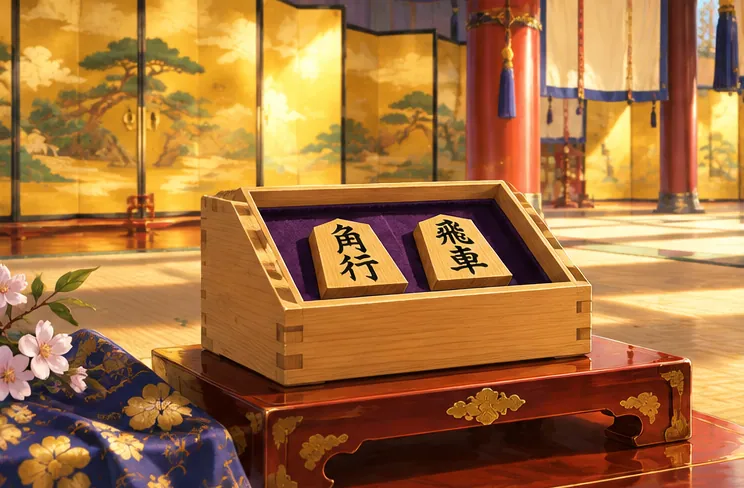
Compared to other board games around the world, the greatest feature of Japanese Shogi is the ability to drop captured pieces back onto open squares of the board as one's own pieces in hand. Thanks to this innovative device, tense battles continue right through the endgame even as pieces on the board decrease. Furthermore, regarding promotion where pieces enter the promotion zone to gain power, flexible strategic depth is allowed, such as choosing whether or not to promote on a qualifying move.
While offering high degrees of freedom, strict rules against fouls have also been established to preserve fairness and excitement. Representative fouls beginners should remember include the following:
- Two Pawns (nifu): Placing 2 of your own unpromoted pawns on the same vertical file.
- Drop pawn mate: Directly checkmating the opponent's king by dropping a pawn from pieces in hand.
- Piece with no moves: Moving or dropping a pawn, lance, or knight to the furthest rank where it cannot advance forward.
- Sennichite and perpetual check: Sennichite, where the same position occurs 4 times, results in a draw, but sennichite caused by perpetual check results in a loss by illegal move for the checking side.
These rules embody the wisdom established through trial and error by our predecessors to preserve competitive balance within the free mechanism of reusing pieces.
Play in the app
The quickest way to understand these concepts is to play and test them. You can play to the very end against an AI that thinks inside your device, even without mobile signal.


The Birth of Dan and Kyu Ranks and the Evolution of Joseki
The system of dan and kyu ranks showing player skill is also an important part of the culture developed across Shogi history. Rooted in an Edo-period system designed to rank master players, a hierarchy was established where players advance upward from kyu ranks below sho-dan to higher dan and kyu ranks. Even with a skill gap, the use of piece handicaps created an environment where anyone could enjoy a balanced match.
In addition, extensive research was devoted to joseki systematizing advantageous opening moves, castles to safely protect the king, and offensive tactics. Representative castles such as Yagura and Mino have been passed down to the present day as fundamental joseki for blunting enemy attacks while establishing footholds for one's own offensive.
Dan and kyu ranks serve not merely as records of wins and losses, but as milestones for feeling one's growth, continuing to inspire enthusiasts today.
Experiencing Modern Shogi Culture on Smartphones

Today, beyond playing across a wooden board and pieces, one can easily experience Shogi's history and depth through smartphones. Facing an AI that operates entirely within the device allows you to practice at your own pace, even offline without an internet connection.
For those wishing to hone their skills in such an environment, titles like Shogi: The Grand Court, which lets you play matches in a story format set in the Warring States period, offer an accessible choice.
By reviewing game records move by move after matches and staying motivated by changes in dan and kyu ranks or ratings matching your skill, even beginners can make steady progress. Experience the rules and wisdom refined over hundreds of years through today's convenient devices.
Frequently asked questions
Around when did the rule of pieces in hand take hold in Shogi history?
It is said to have taken hold between the medieval and Warring States periods. While theories vary, it represents a unique Japanese evolution enabling varied tactics with limited pieces.
What kind of system are dan and kyu ranks?
They are objective metrics indicating a player's ability and skill. Beginners start at kyu ranks and advance to higher dan and kyu ranks as they accumulate victories and prove their skill.
What happens if you commit a foul such as Two Pawns (nifu)?
Committing a foul results in an immediate loss upon playing the illegal move. Rules like Two Pawns (nifu) and drop pawn mate are strictly defined to maintain fairness.
Can Shogi dan and kyu ranks be measured in app matches?
Yes, they can. Many Shogi apps estimate dan and kyu ranks from 15-kyu to 9-dan based on match records and ratings, serving as a guide for your daily improvement.
Play in the app
Become a mechanical daimyo and battle through 50 Warring States court matches in the Shogi app Shogi: The Grand Court. Free to start (contains in-app purchases).