Basic Terms and the Appeal of Shogi Explained in English
Published

As a traditional Japanese board game, Shogi is enjoyed by many people in Japan and around the world. Knowing how to describe Shogi in English helps you share its deep appeal clearly when friends abroad ask how to play.
For those about to learn the rules, we have organized the origins of basic terms and universally recognized English expressions in an accessible way. Grasping the meaning of these words makes following the flow of a game natural.
Expressing Basic Shogi Terms in English
While the game is commonly called "Shogi" overseas as well, introducing it to first-timers as a "traditional Japanese board game" conveys the overall idea easily. The board consists of 81 squares arranged 9×9, described in English as a "shogi board" or a "board of 81 squares."
The most distinctive feature of Shogi is that captured pieces can be returned to empty squares on the board as your own pieces in hand. This reuse is called a "drop" (to drop a piece) in English. Because of this rule, rarely seen in other board games, suspenseful battles continue all the way to the end.
In addition, the mechanism where pieces entering the opposing territory power up is expressed as "promote" (promotion). Connecting concepts to familiar words, such as a pawn promoting to a tokin, deepens understanding.
Piece Roles and English Translations
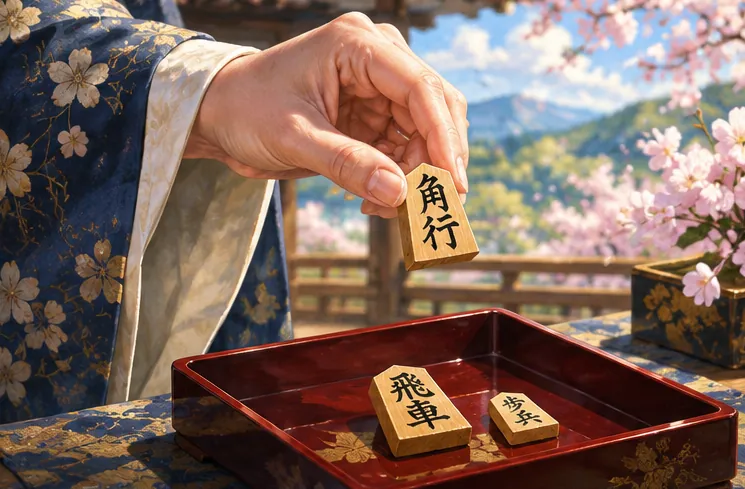
Established English translations exist for the 8 kinds of pieces used in Shogi according to their movement and rank. Many names originate from warriors or court roles, making them easy to learn when tied to their meanings.
| Piece Name | Common English Term | Movement Characteristics |
|---|---|---|
| Gyokushō / Ōshō | King | Moves 1 square in all directions |
| Hisha | Rook | Moves any number of squares horizontally or vertically |
| Kakugyō | Bishop | Moves any number of squares diagonally |
| Kinshō | Gold General | Moves 1 square forward, sideways, or diagonally forward |
| Ginshō | Silver General | Moves 1 square forward or diagonally |
| Keima | Knight | Jumps diagonally 2 squares forward |
| Kyōsha | Lance | Moves any number of squares straight forward |
| Fuhyō | Pawn | Moves only 1 square forward |
Calling the gold general and silver general "General" and the lance "Lance" directly reflects names rooted in Japanese civil war scrolls and samurai battles. The flexibility to choose whether or not to promote on eligible moves is also a refreshing appeal for enthusiasts abroad.
Play in the app
Testing concepts by playing is the fastest shortcut. Play complete games with the AI thinking on your device, even with no signal.


Learning Illegal Moves and Victory Conditions in English
Terms indicating the end of a game also have corresponding words. Threatening to capture the opposing king on the next turn is "check," while eliminating all escape squares to decide the game is "checkmate." The side that checkmates the opponent's king wins.
To ensure fair play, Shogi defines clear illegal moves. Keeping the following points in mind helps when explaining them in English:
- Two Pawns (nifu): An illegal move where you place 2 unpromoted pawns on the same file (vertical column).
- Drop pawn mate: An illegal move where dropping a pawn from pieces in hand delivers an immediate checkmate to the opposing king.
- Piece with no moves: An illegal move where a piece is dropped or moved to a square from which it has no legal moves left, such as the edge of the board.
- Sennichite: A draw occurs when the same board position appears 4 times, but perpetual check results in a loss by illegal move for the checking side.
If you want to master these detailed rules on an actual board, we recommend honing your skills in Shogi: The Grand Court, where you can learn the fundamentals set in a samurai realm.
Recording Games and Steps for Improvement

In Shogi, the written record of moves is called a game record. Reviewing after the end of a match by retracing the board 1 move at a time from move 1 allows you to identify good plays and areas for improvement. Valuing every single move through review is the fastest shortcut to progress anywhere in the world.
Furthermore, dan and kyu ranks serve as benchmarks of ability, starting beginners at grades such as 15-kyu as they aim higher. Striving toward higher dan and kyu ranks while competing against opponents of similar skill is one of the great pleasures of Shogi.
The history of Shogi has long been handed down as a battle of wits among warriors and commoners alike. Discovering the etiquette and strategic depth of the board alongside English terms allows you to enjoy friendly, intellectual matches worldwide. Begin your journey across the board step by step, starting with basic piece movements.
Frequently asked questions
What is Shogi called in English?
It is called Shogi. It is widely understood as is abroad; when you want to explain in detail, describing it as a traditional Japanese board game makes it clear.
How do you say the rule of reusing captured pieces in English?
In English, it is expressed as "drop." It refers to placing captured pieces back onto empty squares of the board as pieces in hand on your turn, serving as a signature feature of Shogi.
What are the main illegal moves in Shogi?
Illegal moves include Two Pawns (nifu), which places 2 pawns on the same vertical column; drop pawn mate, which checkmates the king by dropping a pawn; placing a piece on a square where it has no legal moves; and perpetual check.
What is it called when a piece enters the opponent's territory and changes its function?
It is called promote (promotion). Pieces entering or leaving the promotion zone can choose whether to promote, flipping over to gain enhanced powers such as moving like a gold general.
Play in the app
Become a mechanical lord and fight through 50 court matches in Shogi: The Grand Court, a Shogi app. Free to start with optional in-app purchases.